
John Witherspoon
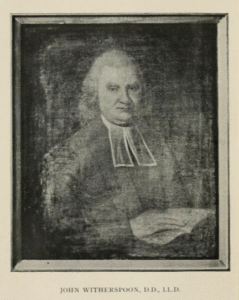 John Witherspoon was President of the College of New Jersey from 1768 – 1794.1 During his tenure as President, the College of New Jersey (now known as Princeton) would require their students to focus on their relationship with Christ as a crucial part of their daily routine…
Every student shall attend worship in the college hall morning and evening at the hours appointed and shall behave with gravity and reverence during the whole service. Every student shall attend public worship on the Sabbath…Besides the public exercises of religious worship on the Sabbath, there shall be assigned to each class certain exercises of their religious instruction suited to the age and standing of the pupils…and no student belonging to any class shall neglect them.2
This was not a casual “chapel” exercise. This was an intentional discipline that all students were expected to adopt that would then become their philosophical starting point for every other intellectual pursuit.
You see that disposition reflected in a sermon he preached entitled, “Glorying in the Cross” where he elaborates on Galatians 6:14:
But God forbid that I should glory, save in the cross of our Lord Jesus Christ, by whom the world is crucified unto me, and I unto the world. (Gal 6:14 [KJV])
He makes the point that the cross is something to be celebrated and prioritized above everything else. He refers to Paul’s resume, as far as him being extremely intelligent when it came to the Word of God and having an intellectual pedigree that could’ve been used to secure a very prestigious position within Jewish culture (Phil 3:1-6). But just as Paul chose to disregard all of his credentials in favor of the cross (Phil 3:7), Witherspoon encourages his listeners to do the same by subordinating everything to that Reality.
At one point in his sermon, he says:
Accursed be all that learning which disguises or is ashamed of the cross of Christ…Accursed be all that learning which is not made subservient to the honour and glory of the cross of Christ.3
This is the academic climate that characterized Witherspoon’s tenure as university President. Consider the way that environment influenced the way his university students would then process themselves and the world around them. Everything would be aligned with however the subject matter was addressed in Scripture. The Bible was the Supreme Authority and the Ultimate Ideal.
This is significant given the way many of Witherspoon’s students would go on to occupy influential positions in government. James Madison being especially noteworthy, given his role in introducing a list amendments to the Constitution which would later be referred to as the Bill of Rights.
In addition, Witherspoon’s influence would be felt in the context of…
12 members of the Continental Congress
5 delegates to the Constitutional Convention
1 president of the United States (James Madison [also referred to as the “Father of the Constitution“)
1 vice president of the United States
28 U.S. senators
49 members of the U.S. House of Representatives
12 governors
3 Supreme Court justices4
He saw reason as something that promoted religion in the way it confirmed the Bible and added to the its beauty and force (see sidebar). It didn’t compete with revelation and wherever it attempted to do so, it was reevaluated as an idea that needed to be either dismissed or altered in order to ensure its consistency with the Perfect Wisdom as articulated in the Word of God.
This was the philosophical starting point for many of those who contributed significantly to the structure and design of our government and the Constitution. However resolved some may be in dismissing the role Christianity had in shaping the Founders approach to liberty and politics, their arguments are revealed as being more passionate then they are principled once an objective inventory is taken, not only of the men who comprised the Constitutional Convention, but also those who influenced them.
1. “John Witherspoon”, David Walker Woods, Fleming H. Revell Company, London, England, 1906, p74, 135
2. “The Laws of the College of New Jersey”, Isaac Collins, Trenton, NJ, 1794, p28-29
3. “The Works of John Witherspoon”, John Witherspoon, HardPress, Miami, FL, 2017, LOC 2,081
4. “John Witherspoon: Educating for Liberty”, George H. Nash, February 19, 2024, Action Institute, https://www.acton.org/religion-liberty/volume-34-number-1/john-witherspoon-educating-liberty, accessed November 30, 2025
5. “Lectures on Moral Philosophy”, John Witherspoon, D.D., L.L.D., Edited under the Auspices of The American Philosophical Association by Varnum Lansing Collins, Princeton University Press, Princeton, N.J., 1912


