
Unclean Lips
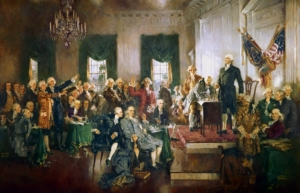 When you take an inventory of all the individuals who have earned a prominent position in our nation’s history, it’s inevitable that you find in each one of them a character flaw of some sort.
- George Washington is the father of our country, yet he was a slaveowner.
- John Witherspoon was a powerful preacher, the President of the University of New Jersey (Princeton), and a signer of the Declaration of Independence. Yet, he was a slaveowner as well.
- Gouvernor Morris wrote the Preamble of the Constitution and spoke more on the Convention floor more so than any other delegate.1 While his faith in God isn’t something you could easily define as orthodox, he belonged to a denomination that believed in a Triune God and his approach to government was obviously informed by a biblical worldview.2 And yet, Morris was involved in several illicit affairs, including those with married women.3
How do you reconcile the way in which history honors these men with the fact that they were fundamentally flawed at some level?
We don’t honor Witherspoon because he owned slaves anymore than we honor Moses for murdering an Egyptian. We don’t respect Morris because he was an adulterer anymore than we applaud David for being in the same category and then went as far as having Bathsheba’s husband killed.
Both the Declaration of Independence and the Constitution represent a brilliant approach to human rights and the structure of government. We don’t evaluate either one of them according to the character flaws of the men who wrote them. Rather, we evaluate them according to the substance of the documents themselves.
In a similar fashion, we don’t honor these men because of the inconsistencies that exist between the doctrine they subscribed to and the way that same doctrine failed to manifest itself in their approach to certain issues. Instead, we honor them because of the sacrifices they made to champion those principles that resulted in the freedoms and the rights we’re able to enjoy today.
When the prophet Isaiah was first commissioned by God, Isaiah is in the Lord’s Presence and instantly becomes aware of how he compares to the standard of God’s Perfection.
He says…
5 “Woe to me!” I cried. “I am ruined! For I am a man of unclean lips, and I live among a people of unclean lips, and my eyes have seen the King, the Lord Almighty.” (Is 6:5)
Anyone who believes themselves to be “qualified” to be used by God in any capacity is inevitably humbled once confronted by the depravity that characterizes themselves along with every member of the human race.
What makes sin so toxic isn’t just the sin itself as much as it’s Who you’re sinning against (Is: 40:12-14; 45:9-10). When you take an honest inventory of Who God is, the idea that a human being would have the audacity to disobey Him or to rebel against Him is unconscionable, and yet…
…that’s what we do all day, every day (Rom 3:23).
It’s not the instrument, but rather than One working in and through that instrument that produces the results that are worthy of our respect and admiration. We applaud our Founding Fathers, not because they were beyond reproach, but because of their willingness to obey and be used by God in a crucial moment when compromise or rebellion would’ve been a far easier path to take.
The assessment that concludes that our Founding Fathers were wrong in the way they viewed certain topics, is neither inaccurate nor inappropriate.
But to dismiss what they accomplished, assuming that any dirt on their hands soils the integrity of the Truth they proclaimed or the substance of the sacrifices they made is to invoke a standard that is not only nonsensical, it is also hypocritical.
1. “Christianity and the Constitution”, John Eidsmoe, Baker Books, Grand Rapids, MI, 1987, 2003, p179
2. Ibid, p189
3 “National Endowment for the Humanities”, “The Confessions of Gouverneur Morris: An interview with Melanie Randolph Miller”, https://www.neh.gov/article/confessions-gouverneur-morris, accessed March 21, 2026
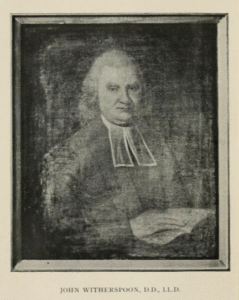 John Witherspoon was President of the College of New Jersey from 1768 – 1794.1 During his tenure as President, the College of New Jersey (now known as Princeton) would require their students to focus on their relationship with Christ as a crucial part of their daily routine…


