
The Constitution
While the Declaration of Independence includes references to the Creator and the Supreme Judge of the Universe, the Constitution is utterly devoid of any mention of God or the supernatural.
Those who want to put as much distance as they can between the United States and her spiritual heritage use that absence to justify insisting that the Constitutional Convention was a purely secular enterprise.
But that wasn’t the case…
In 1787 the United States were anything but united. In many cases, the delegates that convened to retool the Articles of Confederation represented states that were very guarded about the idea of a strong, central government. Instead, they were determined to remain as autonomous as possible, given the way the larger states seemed ready to overwhelm the interests of smaller ones.
Still, there was a prevailing mindset that recognized a loose confederation was incapable of providing the necessary strength needed to levy taxes, enforce laws, and defend against foreign adversaries, many of which were already poised to exploit the apparent weakness of the new nation that had just won her independence. Not only would the Articles of Confederation have to be replaced with a solid Constitution, but a collaboration would have to be established under the heading of a government that subordinated the concept of statehood to “we the people.”
However familiar that phrase is today, it was a brand new idea in the 18th century. While great thinkers had envisioned a representative government in the past, the type of Constitution that needed to be drafted would be the first of its kind.
Part of what made it so challenging is that most monarchies up until that point had built their authority on a partnership between the state and the church that enforced its will by through both a corrupted throne and a corrupted theology.
It was that state sanctioned brand of Christianity that had inspired America’s first settlers to leave their homes and establish colonies where religious freedom could be enjoyed. The Great Awakening took the idea of religious liberty a step further by emphasizing how one’s relationship with the Almighty needed to be a personal decision and not something that could be accomplished in the context of a legislative action. With that spiritual epiphany came the idea that our rights are guaranteed by God and not dispensed by a king, which obviously gave credence to the quest for independence.
But how do you outline a system of government founded on the Divine principles detailed in the Declaration of Independence, and yet not reference them in a way that makes them appear compulsory?
Bear in mind that in some states, should you want to serve in government, you had to belong to a specific denomination in order to be considered.1 When the Constitution was being ratified, Christianity wasn’t just a casual religious exercise, as much as it was ingrained into the culture.
It’s in that context that you want to process the substance of the Constitution.
Critics who want to reduce the Constitution to a purely secular enterprise have to ignore the spiritual perspective of the delegates, the people they represented, and the resources they appealed to for guidance and inspiration.
Dr. M.E. Bradford of the University of Dallas wrote a series of biographical sketches on the fifty-five delegates to the Constitutional Convention. The following table lists the church membership of each of the delegates.3
| Delegate | Denomination |
| New Hampshire | |
| John Langdon | Congregationalist |
| Nicholas Gilman | Congregationalist |
| Massachusetts | |
| Elbridge Gerry | Episcopalian |
| Rufus King | Episcopalian |
| Caleb Strong | Congregationalist |
| Nathaniel Gorham | Congregationalist |
| Connecticut | |
| Roger Sherman | Congregationalist |
| William Samuel Johnson | Episcopalian |
| Oliver Ellsworth | Congregationalist |
| New York | |
| Alexander Hamilton | Episcopalian |
| John Lansing | Dutch Reformed |
| Robert Yates | Dutch Reformed |
| New Jersey | |
| Wiliam Patterson | Presbyterian |
| Wiliam Livingston | Presbyterian |
| Jonathan Dayton | Episcopalian |
| David Blearily | Episcopalian |
| William Churchill Houston | Presbyterian |
| Pennsylvania | |
| Benjamin Franklin | Deist |
| Robert Morris | Episcopalian |
| James Wilson | Episcopalian / Deist |
| Gouverneur Morris | Episcopalian |
| Thomas Mifflin | Quaker / Lutheran |
| George Clymer | Quaker / Episcopalian |
| Thomas FitzSimmons | Roman Catholic |
| Jared Ingersoll | Presbyterian |
| Delaware | |
| John Dickinson | Quaker / Deist |
| George Read | Episcopalian |
| Richard Bassett | Methodist |
| Gunning Bedford | Presbyterian |
| Jacob Broom | Lutheran |
| Maryland | |
| Luther Martin | Episcopalian |
| Daniel Carroll | Roman Catholic |
| John Francis Mercer | Episcopalian |
| James McHenry | Presbyterian |
| Daniel of St Thomas Jennifer | Episcopalian |
| Virginia | |
| George Washington | Episcopalian |
| James Madison | Episcopalian |
| George Mason | Episcopalian |
| Edmund Jennings Randolph | Episcopalian |
| James Blair, Jr | Episcopalian |
| James McClung | Presbyterian |
| George Wythe | Episcopalian |
| North Carolina | |
| William Richardson Davie | Presbyterian |
| Hugh Williamson | Presbyterian / Deist |
| William Blount | Presbyterian |
| Alexander Martin | Presbyterian / Episcopalian |
| Richard Dobbs Spaight, Jr | Episcopalian |
| South Carolina | |
| John Rutledge | Episcopalian |
| Charles Cotesworth Pinckney | Episcopalian |
| Pierce Butler | Episcopalian |
| Charles Pickney III | Episcopalian |
| Georgia | |
| Abraham Baldwin | Congregationalist |
| William Leigh Pierce | Episcopalian |
| William Houstoun | Episcopalian |
| William Few | Methodist |
Two professors, Donald S. Lultz and Charles S. Hynemman, reviewed an estimated 15,000 items, and closely read 2,200 books, pamphlets, newspaper articles, and monographs with explicitly political content printed between 1760 and 1805. They reduced this to 916 items, about one-third of all political writings longer than 2,000 words.
From these items, Lutz and Hynemann identified 3,154 references to other sources. The source most cited by the founding fathers was the Bible, which accounted for 34% of all citations.4
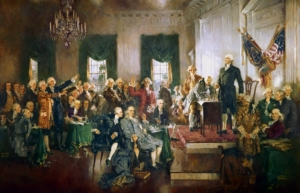
The Constitution was referred to as a “miracle” by George Washington. He presided over all the proceedings and was there to watch the negotiations first hand (see sidebar).
With each state you had a religious and economic culture that was, in some cases, very distinctive. With that distinction came a specific set of expectations and anxieties that needed to be addressed and resolved in a way that allowed for the birth of a nation as opposed to an argument between neighbors.
This was accomplished only because of a willingness to acknowledge an Authority that transcended politics. John Adams said it best when he said, ““We have no government armed with power capable of contending with human passions unbridled by morality and religion. Avarice, ambition, revenge or gallantry would break the strongest cords of our Constitution as a whale goes through a net. Our Constitution is designed only for a moral and religious people. It is wholly inadequate for any other.”6
Without a Divine Absolute as the starting point – without incorporating the Biblical Principles outlined in the Declaration of Independence – real collaboration and true community is overwhelmed by selfishness posing as entitlement.
1. “Constitution Annotated”, “ArtVI.C3.2.1 Historical Background on Religious Test for Government Offices”, https://constitution.congress.gov/browse/essay/artVI-C3-2-1/ALDE_00013638/#ALDF_00027145, accessed May 6, 20262.
2. “Library of Congress”, “Religion and the Founding of the American Republic”, https://www.loc.gov/exhibits/religion/rel02.html, accessed May 6, 2026
3. M.E. Bradford, (Marlborough, N/H.: Plymouth Rock Foundation, 1982), pp iv-v
4.”Christianity and the Constitution”, John Eidsmore, Baker Book House Company, Grand Rapids, MI, 1987, p51
5. “Teaching American History”, “Letter from George Washington to Marquis de LaFayette (1787), https://teachingamericanhistory.org/document/letter-to-marquis-de-lafayette-6/, accessed June 4, 2026
6. John Adams (1854). “The Works of John Adams, Second President of the United States: With a Life of the Author, Notes and Illustrations”, p.229
 When you take an inventory of all the individuals who have earned a prominent position in our nation’s history, it’s inevitable that you find in each one of them a character flaw of some sort.


